 Drive and Maintain
The sidewall: 205/55 R16 91V
| Marking | What it means |
|---|---|
| 205 | Width, in millimetres |
| 55 | Profile: the sidewall's height as a % of the width |
| R | Radial construction |
| 16 | Fits a 16-inch wheel |
| 91 | Load index: 615 kg per tyre |
| V | Speed rating: up to 149 mph |
Fit the size, load index and speed rating in your handbook or on the door sticker, or higher. Insurers can refuse claims for the wrong tyres.

Tyre speed ratings, L to Y
The letter after the load index: the top speed the tyre is made for, fully loaded.
| Rating | Top speed | Usually on |
|---|---|---|
| L | 75 mph (120 km/h) | Off-road and light trucks |
| M | 81 mph (130 km/h) | Off-road and light trucks |
| N | 87 mph (140 km/h) | Space-saver spares |
| P | 93 mph (150 km/h) | Light trucks |
| Q | 99 mph (160 km/h) | Winter tyres, vans |
| R | 106 mph (170 km/h) | Vans and light trucks |
| S | 112 mph (180 km/h) | Family cars, vans |
| T | 118 mph (190 km/h) | Family cars |
| U | 124 mph (200 km/h) | Family cars |
| H | 130 mph (210 km/h) | Saloons and hatchbacks |
| V | 149 mph (240 km/h) | Faster saloons |
| W | 168 mph (270 km/h) | Performance cars |
| Y | 186 mph (300 km/h) | Performance cars |
Tyre load index chart
The number before the speed letter: the most one tyre may carry, at its full pressure. A car's tyres are usually 75 to 105; vans' and lorries' higher.
Other tyre markings
DOT date
Four digits at the end of the DOT code: the week and year it was made. 2324 is the 23rd week of 2024. Many experts advise replacing tyres older than about 10 years, whatever the tread.
XL or Reinforced
Built to carry more load at a higher pressure; often needed on heavier cars and vans.
M+S
Mud and snow: the tread suits slush and mud, but it isn't a winter tyre on its own.
Mountain and snowflake (3PMSF)
Passes a test for snow: winter tyres and the better all-season tyres carry it.
Run-flat (RFT, ROF, SSR)
Can be driven a short way at reduced speed after a puncture: see the handbook.
TWI
Tread wear indicators: small bars in the grooves. When the tread is level with them it's at 1.6 mm.
ZR
Radial, made for over 240 km/h (149 mph).
PART WORN
A part-worn tyre must by law have at least 2 mm of tread across its full width, no structural damage or exposed cord, and carry this mark.
The tyre label
The label on a new tyre grades it three ways. Wet grip matters most for safety.
Fuel efficiency (A to E)
Rolling resistance: A uses least fuel or charge. A to E can be several per cent of your fuel.
Wet grip (A to E)
How well it brakes in the wet: from 50 mph an A-rated tyre can stop many metres shorter than an E.
Noise (A to C, and dB)
The outside noise, in decibels: fewer sound waves on the label means quieter.
Snow and ice
Newer labels show a symbol when a tyre is approved for snow or for ice.
Tread, pressures and age
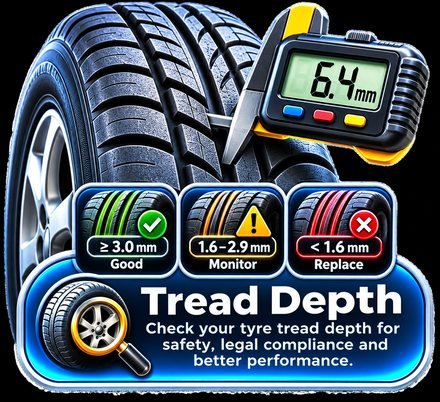

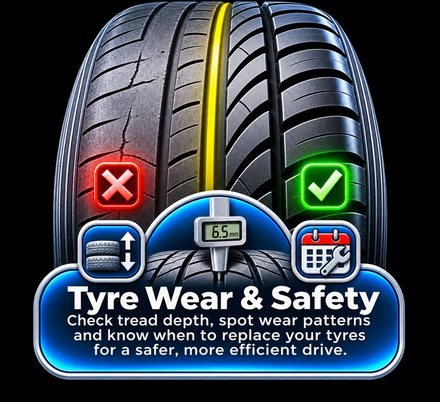
A puncture in the central three-quarters of the tread can often be repaired; one in the shoulder or sidewall cannot.
Read the sidewall at the roadside
Dashboard → Tyres → Tyres → Understanding your tyresFree
- Starts with your own vehicle's tyre size, read out part by part
- Tyre labels explained (Tyres → Tyre Labels) has every speed rating and the load index chart
- Tyre Ages & Loads keeps each wheel's DOT date and age, and its load against the axle
Drive and Maintain is the vehicle maintenance and MOT reminder app for iPhone: MOT, tax, insurance and service reminders, mileage and fuel tracking, and every tool on this site, in your pocket.
Frequently asked
What does 205/55 R16 91V mean?
205 mm wide, a sidewall 55% as tall as that, radial, for a 16-inch wheel, load index 91 (615 kg a tyre) and speed rating V (up to 149 mph).
How do I tell how old my tyres are?
Find the DOT code on the sidewall: its last four digits, often in an oval, are the week and year it was made. 2323 is week 23 of 2023.
What is the legal tread depth in the UK?
At least 1.6 mm across the central three-quarters of the tread, all the way round, for cars and light vans. The fine is up to £2,500 and three penalty points for each tyre. Most advice is to change at 3 mm.
What does XL mean on a tyre?
Extra Load, or Reinforced: built to carry more at a higher pressure, often needed on heavier cars and vans.
What is the difference between M+S and the snowflake symbol?
M+S is the maker's own claim that the tread suits mud and snow. The three-peak mountain snowflake (3PMSF) means the tyre has passed a test in snow: winter tyres and the better all-season tyres carry it.