 Drive and Maintain
Lorry and bus drivers who are covered by the drivers' hours rules also have working time limits. They're separate, and both apply.
What counts as working time
Driving, and other work: loading and unloading, checks, cleaning, paperwork, and time when you must be at work and ready to start. Breaks, rest and periods of availability (where you know in advance how long you'll wait) don't count.
The limits
- An average of 48 hours a week, normally over a 17-week reference period.
- No more than 60 hours in any single week.
- Night work: no more than 10 hours of work in any 24 hours if you work at night.
Breaks
You mustn't work more than six hours without a break:
- at least 30 minutes if you work between six and nine hours; and
- at least 45 minutes if you work more than nine hours.
Breaks can be split into periods of at least 15 minutes.
Records
Employers must keep records of working time. Self-employed drivers have their own rules.
Both rules apply
Being within the drivers' hours limits doesn't mean you're within working time, and the other way round. DVSA's guidance has the details.
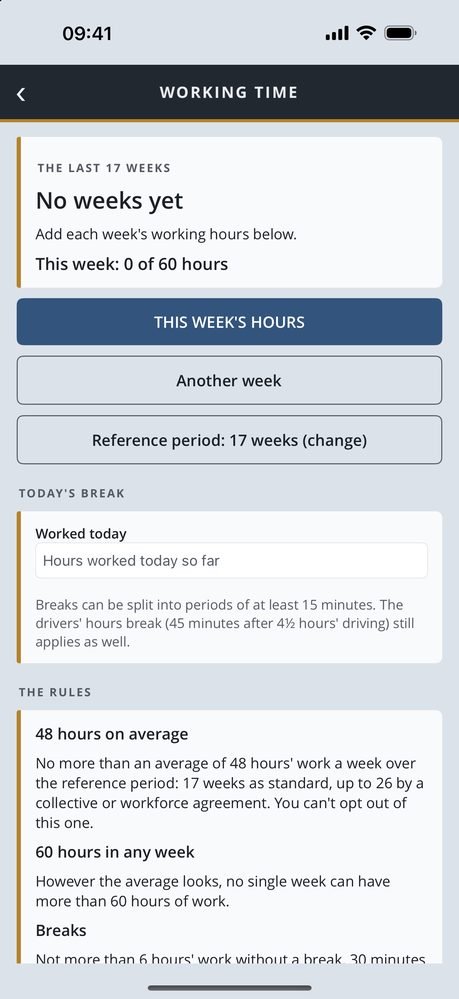
In the app
Drive and Maintain's Working time tracks the 48-hour average, alongside the drivers' hours and hours used.
MOT, tax, insurance and service reminders
Reminders before every date runs out, mileage and fuel tracked with your real MPG, and the service history kept, for every vehicle you look after.