 Drive and Maintain
Tyres don't wear evenly. On most cars the front tyres do the steering and, on a front-wheel-drive car, the driving too, so they wear faster than the rears. Rotating them, moving them between positions at intervals, evens the wear out so the set lasts longer and can be replaced together.
The usual patterns
- Front to back on the same side: the simplest, and the only option for directional tyres (the ones with an arrow on the sidewall showing which way they turn).
- Crossing over: on some cars, tyres move from front to back and swap sides as they go. The pattern depends on whether the car is front-, rear- or four-wheel drive.
The handbook says which pattern, and how often, for your car. Some manufacturers don't recommend rotating at all.
When it doesn't apply
- Different sizes front and rear ("staggered" fitments): the tyres can't swap.
- Directional or asymmetric tyres limit which way they can move.
- A tyre already much more worn than the others: rotating won't fix that. Check the tread and the pressures first.
Where the better tyres go
If you're only replacing two tyres, the general advice is to fit the newer pair on the rear, for stability in the wet. Your tyre fitter will advise.
Keep a record
It's easy to forget when the tyres were last rotated, and which tyre was where. A note of each rotation, with the mileage, makes the next one simple.
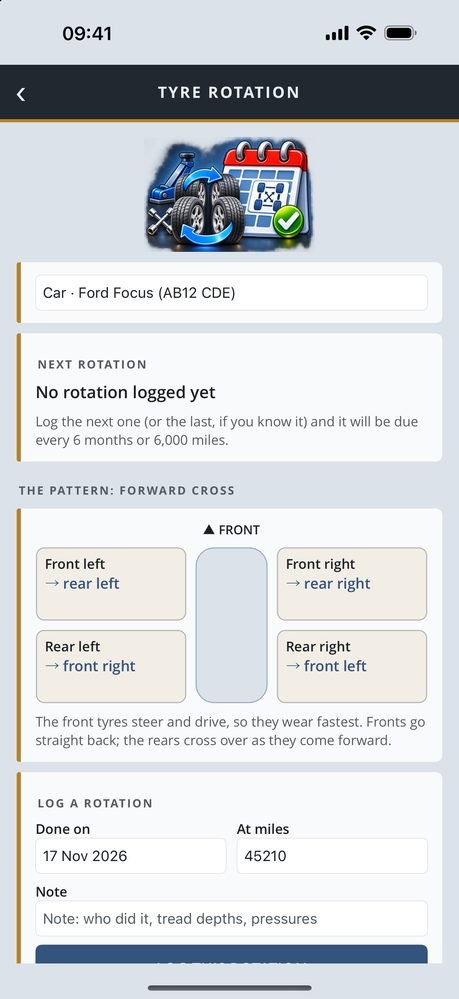
In the app
Drive and Maintain shows the rotation pattern wheel by wheel, keeps each wheel's age and load, and the record of every tyre check and change.
MOT, tax, insurance and service reminders
Reminders before every date runs out, mileage and fuel tracked with your real MPG, and the service history kept, for every vehicle you look after.