 Drive and Maintain
Most cars in the UK come on summer tyres, but there are three main types, and the choice is mostly about temperature.
Summer tyres
Despite the name, they're the standard tyre for most of the UK, most of the time. Their rubber gives the best grip and braking in mild and warm conditions, wet or dry. In cold weather, roughly below about 7°C, tyre makers say the rubber hardens and grip drops.
Winter tyres
A softer compound that stays grippy in the cold, with deep tread and many small slits (sipes) for snow, slush and ice. Marked with the three-peak mountain snowflake symbol. They wear faster in warm weather.
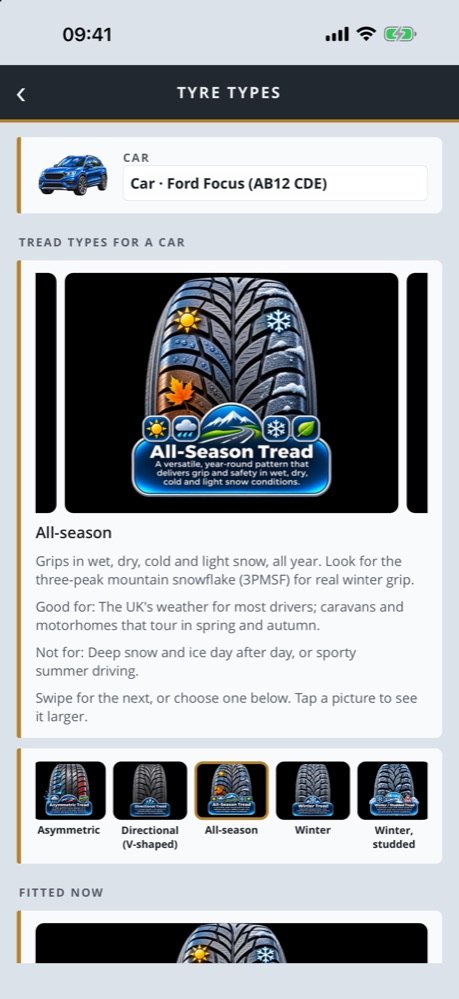
All-season tyres
A compromise: decent in both warm and cold, without being the best at either. Good all-season tyres also carry the mountain snowflake symbol, and they mean no swapping over.
Which suits you?
- Mostly towns and main roads in a mild area: summer tyres are usually fine.
- Rural, hilly or high areas, or a car you must be able to use in any weather: consider all-season, or winter tyres in the cold months.
- Driving in Europe in winter: some countries require winter tyres or snow chains in certain conditions.
Tell your insurer
Changing to winter or all-season tyres usually doesn't affect cover, but some insurers like to know.
Same type on all four
Fit the same type on all four wheels, for balanced handling.
In the app
Drive and Maintain pictures every tread type, and keeps each vehicle's tyres, their sizes and their ages.
MOT, tax, insurance and service reminders
Reminders before every date runs out, mileage and fuel tracked with your real MPG, and the service history kept, for every vehicle you look after.