 Drive and Maintain
Most drivers underestimate how far a car travels before it stops. The Highway Code's figures surprise people, and they're for a good car, a dry road and an alert driver.
Thinking plus braking
A stopping distance is two parts added together:
- Thinking distance: how far you travel between seeing the hazard and pressing the brake.
- Braking distance: how far you travel once the brakes are on.
The Highway Code's figures
- 20 mph: 6 m thinking + 6 m braking = 12 m
- 30 mph: 9 m + 14 m = 23 m
- 40 mph: 12 m + 24 m = 36 m
- 50 mph: 15 m + 38 m = 53 m
- 60 mph: 18 m + 55 m = 73 m
- 70 mph: 21 m + 75 m = 96 m
Double the speed from 30 to 60 and the stopping distance more than triples: braking distance grows with the square of the speed.
What makes them longer
- Wet roads: stopping distances can be at least double.
- Ice: up to ten times longer.
- Tiredness, alcohol, drugs or a phone all make the thinking distance longer.
- Worn tyres and brakes, and a heavy load or a trailer, make the braking distance longer.
The two-second rule
Leave at least a two-second gap to the vehicle in front on a dry road, and at least four in the wet. Pick a fixed point, and count as the vehicle in front passes it.
The free stopping distances tool works them out for any speed and road.
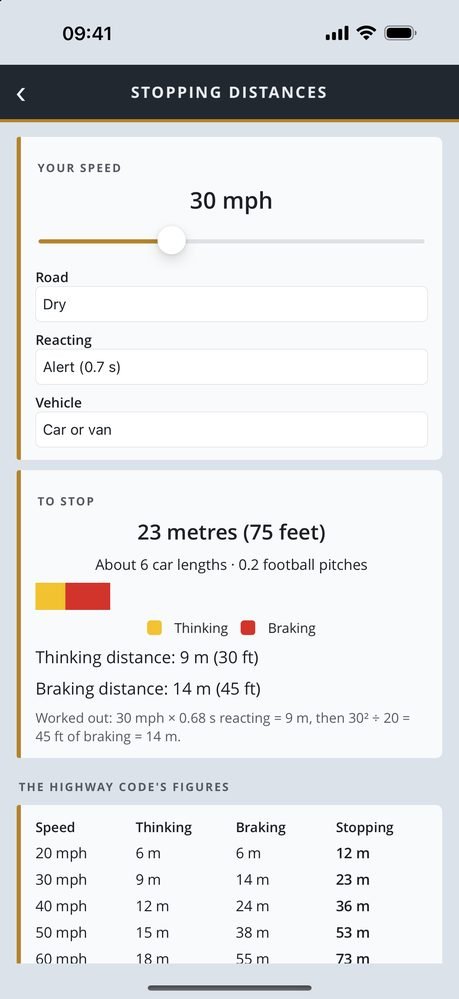
In the app
Drive and Maintain has the stopping distances for every speed, dry, wet and icy, alongside its road signs and road quiz.
MOT, tax, insurance and service reminders
Reminders before every date runs out, mileage and fuel tracked with your real MPG, and the service history kept, for every vehicle you look after.