 Drive and Maintain
Britain has several kinds of crossing, with names that sound like a zoo. Here's how each works for drivers.
Zebra crossings
Black and white stripes, flashing yellow beacons, no traffic lights. Give way to people on the crossing, and be ready to stop for those waiting to cross.
Pelican crossings
Traffic lights controlled by a button, with a flashing amber phase. On flashing amber, you may go only if the crossing is clear: give way to anyone still crossing.
Puffin crossings
Sensors watch the crossing, and the lights stay red until people are across. No flashing amber: the sequence is the same as ordinary traffic lights.
Toucan crossings
For pedestrians and cyclists ("two can" cross). No flashing amber.
Pegasus crossings
For horse riders, with higher buttons.
The zigzags
The zigzag lines each side of a crossing mean no parking, no stopping (except to give way or in a queue), and no overtaking the leading vehicle approaching the crossing.
Never wave people across
Don't wave pedestrians across: another driver may not have stopped.
Queuing
Don't stop on a crossing in queuing traffic: keep it clear.
In the app
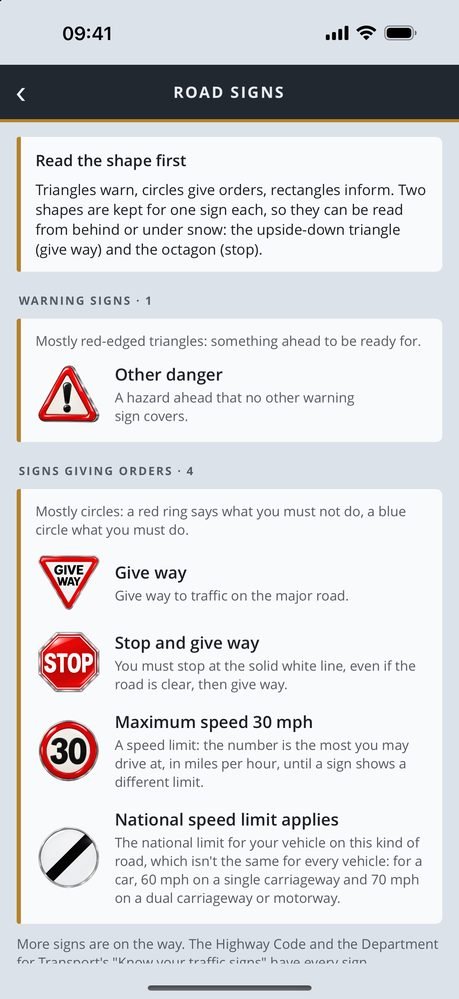
Drive and Maintain has the road signs, warning signs and signs giving orders, and the road quiz to test yourself.
MOT, tax, insurance and service reminders
Reminders before every date runs out, mileage and fuel tracked with your real MPG, and the service history kept, for every vehicle you look after.