 Drive and Maintain
When the engine management light comes on, the car's computer has stored a fault code saying what it found. Reading that code turns a worrying light into something you can understand.
What OBD is
On-board diagnostics is the car's self-monitoring system. Modern cars have a standard OBD port, usually under the dashboard near the steering column. Plug in a code reader (many are cheap, and some connect to a phone) and it shows the stored codes.
Reading a code
Codes are five characters, like P0420:
- The letter says which system: P powertrain (engine and gearbox), B body, C chassis, U network.
- 0 after the letter means a generic code, the same on every make; 1 is usually manufacturer-specific.
- The rest narrows it down: P0420, for example, is about the catalytic converter's efficiency.
A code is a clue, not a diagnosis
A code says what the computer noticed, not always why. A misfire code could be a spark plug, a coil, an injector or a vacuum leak. Use it to ask the right questions, or to check a garage's explanation.
Clearing it isn't fixing it
Most readers can clear codes and turn the light off. If the fault is still there, it comes back. And clearing codes just before an MOT is noticed: the car reports that its checks haven't finished running.
When to stop
A flashing engine light usually means a misfire that can damage the catalytic converter. Slow down and get it seen to straight away.
In the app
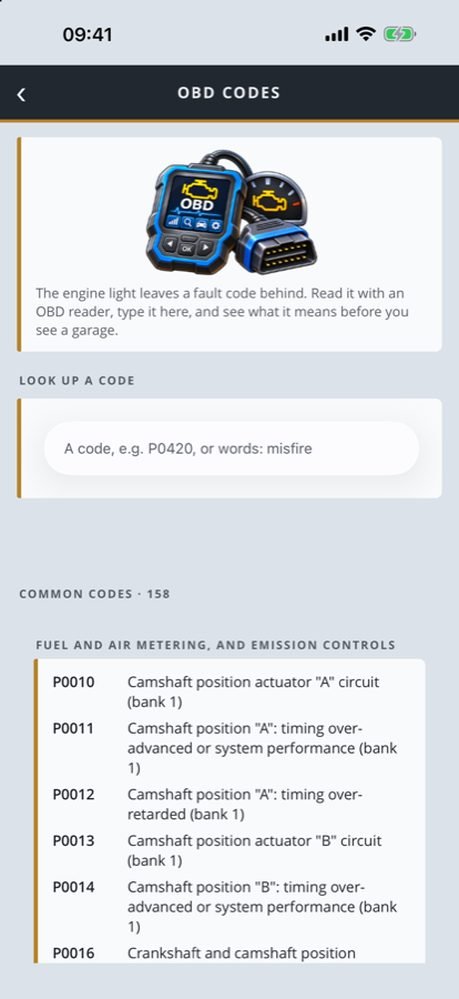
Drive and Maintain looks up OBD fault codes in plain English, alongside its guide to every dashboard warning light.
MOT, tax, insurance and service reminders
Reminders before every date runs out, mileage and fuel tracked with your real MPG, and the service history kept, for every vehicle you look after.