 Drive and Maintain
A motorbike's suspension is set up for a particular weight. If it's set wrongly for you, the bike won't handle as well as it should. Sag is the starting point.
What sag is
Sag is how much the suspension compresses:
- Static sag (or free sag): under the bike's own weight.
- Rider sag (or race sag): with you on it, in your kit, in your riding position.
Why it matters
Too little sag, and the suspension is too stiff for you: harsh, and the tyres can lose contact over bumps. Too much, and it's too soft: it can bottom out, and steering geometry changes.
Measuring it
It's easiest with two helpers:
- Lift the bike so the suspension is fully extended, and measure between two fixed points (for example, the rear axle and a point on the seat unit).
- Measure again with the bike on its wheels.
- Measure again with you on it, in your kit, feet on the pegs, while a helper steadies the bike.
The differences are the static and rider sag. The handbook or a suspension specialist gives the target figures for your bike.
Adjusting it
Sag is usually set with the preload adjuster. Change it in small steps, and measure again.
When to check
When you buy a bike, when your weight changes, and if you start carrying a passenger or luggage regularly.
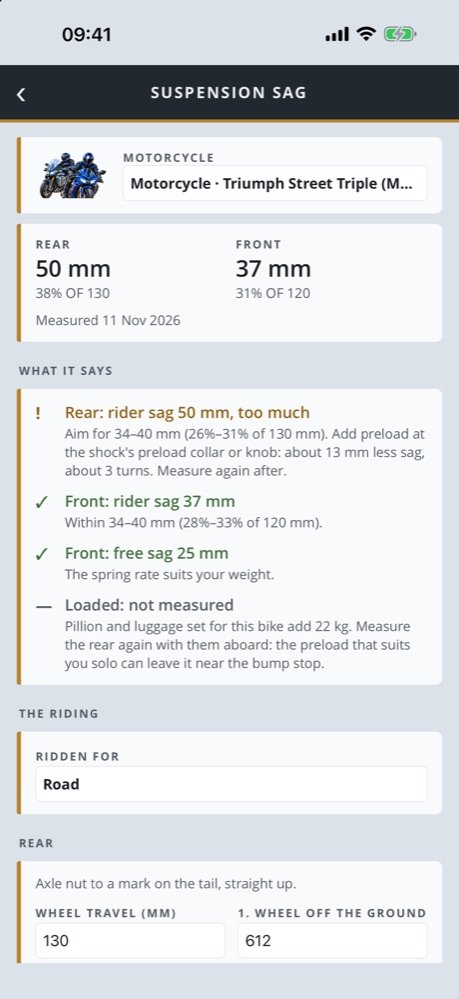
In the app
Drive and Maintain has a suspension sag screen for your bike, alongside chain care and riding kit.
MOT, tax, insurance and service reminders
Reminders before every date runs out, mileage and fuel tracked with your real MPG, and the service history kept, for every vehicle you look after.