 Drive and Maintain
Most of the time, a car's exhaust shouldn't smoke visibly. When it does, the colour is a clue.
Thin white vapour on a cold morning
Normal: condensation. It disappears once the engine warms up.
Thick white smoke that doesn't go away
Often coolant burning in the engine, a sign of a failing head gasket or worse. It may smell sweet, and the coolant level drops. Get it checked soon: an engine can overheat and be badly damaged.
Blue or grey smoke
Oil is burning. Common causes are worn piston rings, valve seals or a failing turbo. Check the oil level often, and get it diagnosed.
Black smoke
Too much fuel being burned. On a diesel, a puff under hard acceleration can be normal on older cars, but constant black smoke can mean a clogged air filter, faulty injectors, a turbo problem, or a sensor fault. It's an MOT emissions issue.
Smoke at start-up only
A puff of blue smoke at start-up, then clear, can be worn valve seals.
Get it checked
Smoke means something isn't right. A garage can diagnose it, and it's cheaper to catch early.
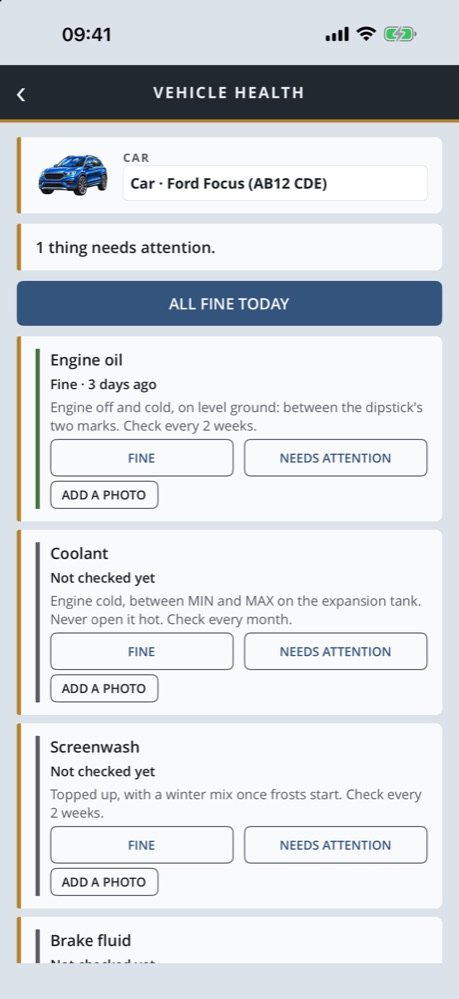
In the app
Drive and Maintain's vehicle health lists the checks for each kind of vehicle.
MOT, tax, insurance and service reminders
Reminders before every date runs out, mileage and fuel tracked with your real MPG, and the service history kept, for every vehicle you look after.