 Drive and Maintain
At night, you see less, others see you less, and you're more likely to be tired.
Clean glass, clean lights
A dirty windscreen, inside and out, scatters light into glare. Clean it regularly, and the headlights too.
Using your lights
- Dipped headlights in the dark and whenever visibility is reduced.
- Full beam on unlit roads when nothing is coming, but dip for oncoming traffic, and when following another vehicle.
- Check every bulb works: a car with one headlight can look like a motorbike.
Dazzle
If you're dazzled by oncoming lights, slow down, and look towards the left kerb or verge rather than into the lights. If you're dazzled, stop safely.
Your eyes
- Have your eyes tested regularly: night vision gets worse with age, and some conditions affect it first.
- Anti-glare lens coatings can help; tinted lenses shouldn't be worn at night.
Speed and distance
Drive at a speed that lets you stop within the distance you can see to be clear: on an unlit road, that's within your headlights.
Tiredness
The body clock dips at night. Plan breaks, and stop if you feel sleepy.
Watch for
Pedestrians, cyclists without lights, and animals on country roads.
In the app
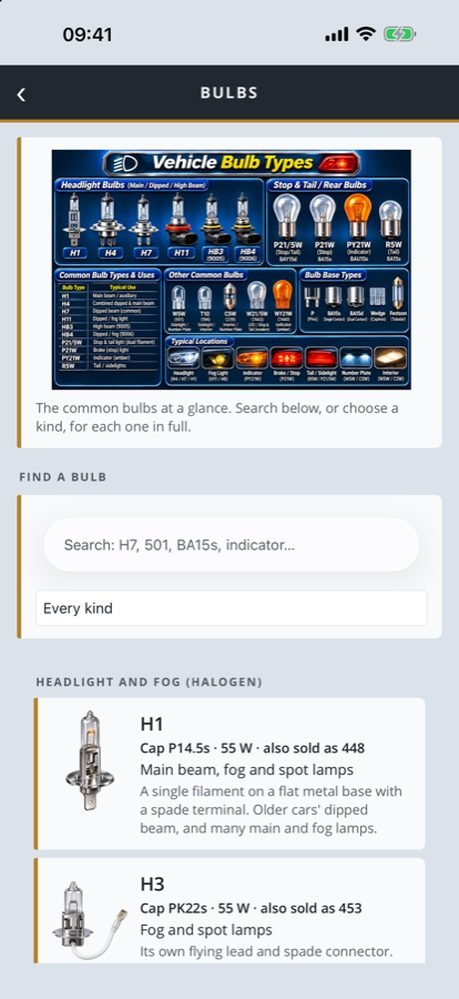
Drive and Maintain pictures every common bulb, with a search, so you know which one to buy when a light goes.
MOT, tax, insurance and service reminders
Reminders before every date runs out, mileage and fuel tracked with your real MPG, and the service history kept, for every vehicle you look after.