 Drive and Maintain
A well-fitted child seat is one of the most important things in the car. And the law is specific.
The law
Children must normally use a child car seat until they're 12 years old or 135 cm tall, whichever comes first. After that, they must wear a seat belt.
Seats must be EU-approved: look for a label with a capital E in a circle, and R44 or R129 (i-Size). Seats are chosen by the child's height (R129) or weight (R44).
Rear-facing seats and airbags
You must not fit a rear-facing baby seat in a front seat with an active airbag. Turn the airbag off first, if the car allows it, or use the back seat.
Fitting it right
- Follow the seat's instructions and the car's handbook.
- ISOFIX points make fitting easier and more secure.
- Belt-fitted seats need the belt routed exactly as shown, and pulled tight.
- The harness should be snug: you shouldn't be able to pinch slack at the shoulder.
- Take bulky coats off before strapping a child in: they stop the harness fitting closely.
Many retailers and some councils offer free fitting checks.
Second-hand seats
Only use one if you know its history: a seat that's been in a crash may be damaged invisibly.
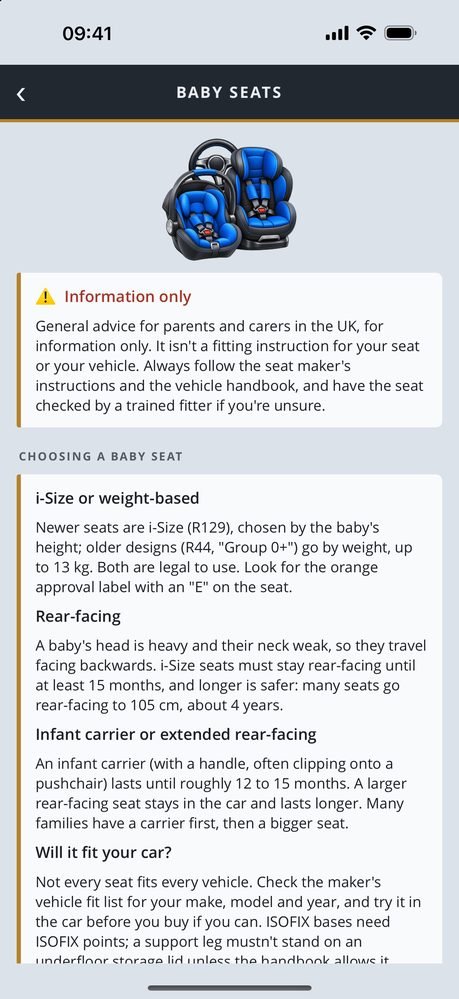
In the app
Drive and Maintain's Baby seats has the advice, and keeps each seat's instructions, so they're to hand when you move it between cars.
MOT, tax, insurance and service reminders
Reminders before every date runs out, mileage and fuel tracked with your real MPG, and the service history kept, for every vehicle you look after.