 Drive and Maintain
If you use your own vehicle for work, the miles can be worth a lot at the end of the tax year. But only the right miles, and only if they're written down.
What counts
- Business journeys count: to see a client, to a temporary workplace, between sites, to a training course.
- Your normal commute doesn't: home to your permanent workplace and back is private, whoever pays for the fuel.
- A temporary workplace is one you go to for a limited task or period, generally expected to be under two years. Travel there counts.
HMRC's approved rates
For business miles in your own vehicle in a tax year (6 April to 5 April):
- Cars and vans: 45p a mile for the first 10,000 miles, then 25p.
- Motorcycles: 24p a mile.
- Bicycles: 20p a mile.
If your employer pays less than these rates, you can usually claim tax relief on the difference. The free mileage allowance calculator does the sums.
What to write down
For each business journey:
- The date.
- Where from and where to.
- Why: who you saw, or what the job was.
- The miles.
Odometer readings at the start and end of the tax year help show the totals add up.
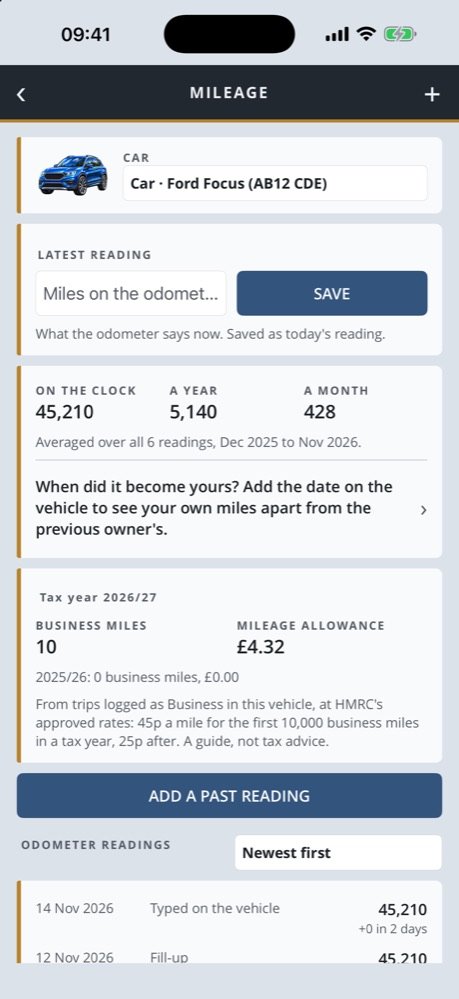
In the app
Drive and Maintain logs trips by GPS, each marked business, personal or commuting, and adds the tax year's business miles up into the claim at HMRC's rates, alongside every odometer reading. It's a guide, not tax advice.
MOT, tax, insurance and service reminders
Reminders before every date runs out, mileage and fuel tracked with your real MPG, and the service history kept, for every vehicle you look after.