 Drive and Maintain
A Blue Badge helps people with disabilities or health conditions park closer to where they need to go. The rules are simple, but easy to get wrong.
Who can use it
The badge is for the badge holder. It can only be used when the holder is travelling in the vehicle, as the driver or a passenger, or being dropped off or picked up. Using it for anyone else's convenience is an offence, and misuse can mean a fine of up to £1,000 and the badge being taken away.
Where you can park
Rules vary by area, so always check the signs. Commonly:
- In disabled bays.
- On single or double yellow lines, for a limited time (often up to three hours), if there's no loading restriction (yellow marks on the kerb) and it's safe.
- In on-street pay-and-display or meter bays, often free and without a time limit.
Private car parks, such as supermarkets, set their own rules.
Display it properly
- On the dashboard, the right way up, with the hologram side visible.
- Set the parking clock to your arrival time when parking on yellow lines.
Renewing
A Blue Badge usually lasts three years. Apply to renew well before it runs out: it can take a while.
Where you can't
Clearways, bus and cycle lanes during their hours, zigzags at crossings, and anywhere it would cause danger or obstruction.
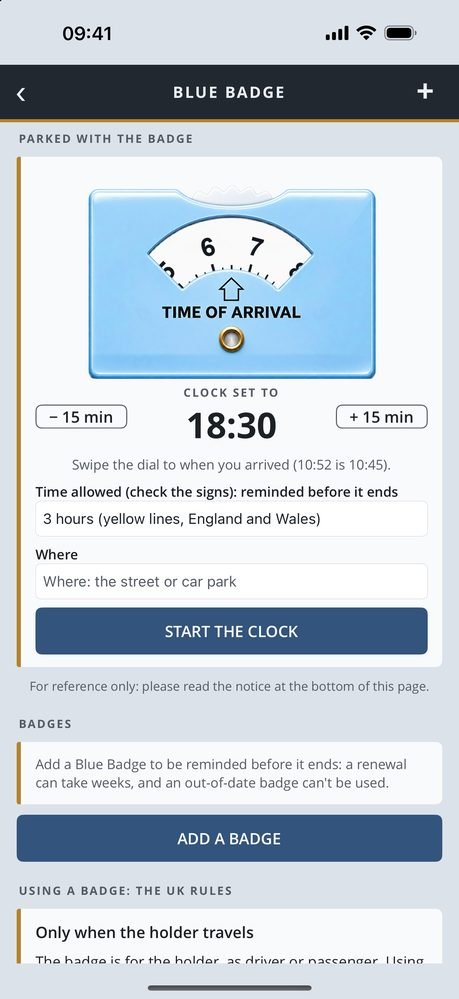
In the app
Drive and Maintain's Blue Badge has the parking clock and the rules.
MOT, tax, insurance and service reminders
Reminders before every date runs out, mileage and fuel tracked with your real MPG, and the service history kept, for every vehicle you look after.